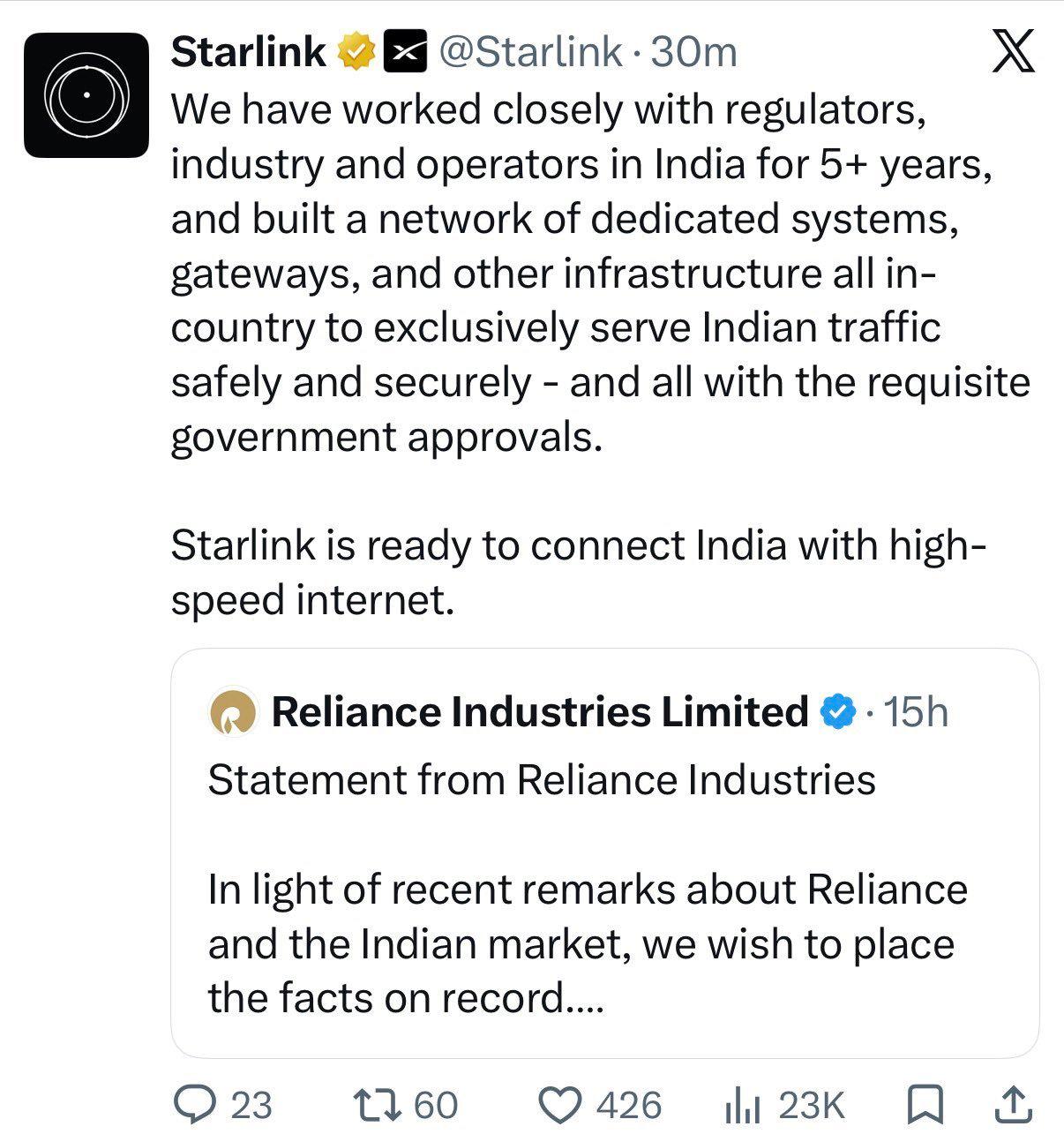


Starlink, Jio and Airtel satellite plans in India
None of the three has launched commercial satellite broadband in India yet. All are waiting for spectrum assignment and final security clearances.
Partnerships
Jio has a joint venture with SES (51:49) for GEO and MEO capacity. It also signed a 2025 distribution deal with Starlink. It is preparing its own sovereign constellation of around 1,600 LEO satellites (future plan).
Airtel has a major stake in Eutelsat OneWeb and also signed a 2025 distribution deal with Starlink.
Can Starlink work without them?
Yes. Starlink has its own licence and ground infrastructure and can sell directly. The deals with Jio and Airtel are mainly for distribution, retail support and installation help.
Existing infrastructure advantage (Indian customer view)
Jio and Airtel can make the service easier and more practical for Indian customers through their retail network, bundling with existing mobile or fibre plans, EMI style hardware payments, local installation support and hybrid terrestrial plus satellite services. This is their main edge. Starlink has the advantage on pure satellite capacity and latency.
Expected costs
Starlink: Analyst estimates of ₹2,500 to ₹3,500 per month for retail, plus hardware of ₹33,000 to ₹34,000. Official price is not confirmed (a higher test listing was removed).
Airtel / OneWeb: No consumer price published. Mainly enterprise and custom contracts. Professional terminals are costlier.
Jio / SES: No official price. Enterprise oriented. Hardware is likely to be subsidised or bundled for existing customers.
Retail versus enterprise focus
Starlink’s core strength is retail and rural residential broadband. In India, early uptake is expected to be heavier on enterprise and remote sites because of high costs.
Customers they are targeting
Jio: Enterprises, small and medium businesses, mobile backhaul, remote communities, schools and health centres. Also retail customers for Starlink kits. Future own LEO plan also covers defence, maritime, aviation and direct to device.
Airtel: Enterprises, government, maritime, aviation, business customers and remote communities. Also retail equipment sales for Starlink.
Defence and international deals
Airtel / OneWeb: Used by the Indian Army and Navy (Myanmar relief, Sri Lanka floods, Navy voyage). Strong international deals including French Armed Forces (up to €1 billion) and UK government worldwide.
Jio / SES: Indian defence trials done. Future sovereign LEO plan is positioned for defence and national security. No major public international defence satcom deals yet for the joint venture.
Technology comparison
Starlink: LEO at around 550 km, about 11,000 satellites, latency around 25 to 60 ms. Best on speed, latency and capacity.
Airtel / OneWeb: LEO at around 1,200 km, about 650 satellites, latency around 40 to 70 ms. Better for enterprise service levels and polar coverage. Adding more satellites for capacity, but staying at higher orbit.
Jio / SES (current): Higher latency GEO and MEO. Own LEO plan (aligned with 6G non terrestrial network) is still a proposal.
Other points
Satellite will remain much costlier than fibre or fixed wireless for most users and is mainly useful for hard to reach areas. Jio is integrating satellite into its 6G roadmap. Sovereignty and data control are key themes for Jio’s own constellation.
In EconSphere