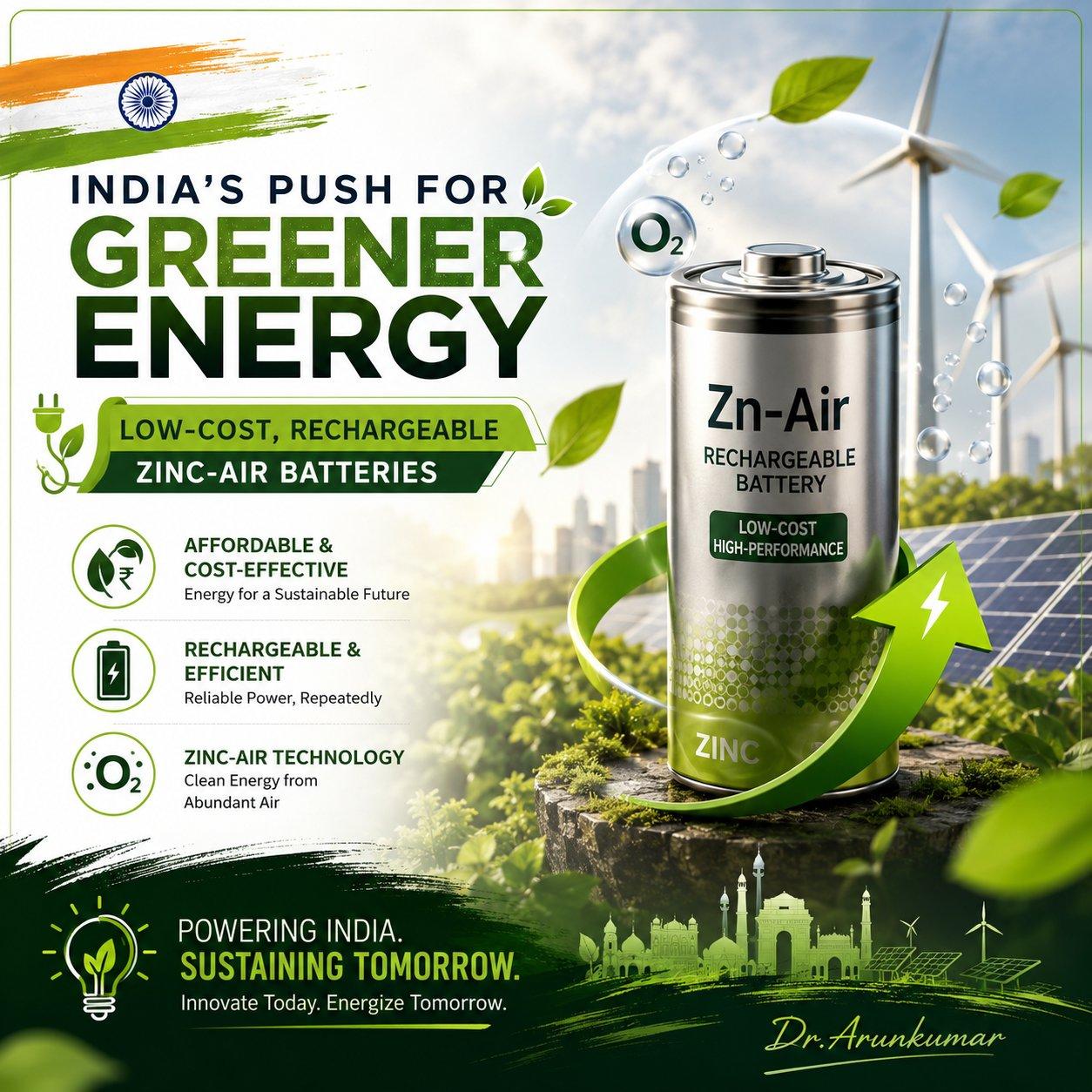


India is rapidly advancing its green energy ecosystem by developing low-cost, electrically rechargeable zinc-air batteries (ZABs) as a safer, sustainable alternative to lithium-ion systems. Backed by the government's Department of Science and Technology (DST), recent homegrown breakthroughs have successfully tackled the critical corrosion and catalyst bottlenecks that historically restricted these water-based batteries from being easily recharged.
Core Technical Breakthroughs
A team led by Dr. S. Devaraj at SASTRA Deemed University achieved a major material science breakthrough:
Nanofluid Electrolyte: Dispersing cheap silica and zinc oxide nanoparticles into standard electrolyte suppresses parasitic hydrogen gas evolution and zinc metal corrosion simultaneously.
Precious-Metal Free Catalyst: Researchers developed a copper-doped manganese dioxide (α-MnO2) catalyst that outpaces commercial platinum and ruthenium standards using just a 2 wt% dopant loading.
Waste-to-Energy Upcycling: The system integrates carbon derived from exhausted household water filters and recycled surgical face masks to build high-performance battery electrodes.
Strategic & Economic Economic Value
India's focus on zinc-based battery engineering provides several distinct macro advantages:
Resource Independence: India holds abundant zinc reserves, enabling a domestic supply chain that bypasses heavy geopolitical reliance on imported lithium and cobalt.
Extreme Cost Efficiency: Zinc-air systems are estimated at roughly $150 per kWh (projected to drop below $100 per kWh with mass adoption), contrasting sharply with lithium-ion’s $200–$250 per kWh cost structure.
Operational Safety: Built with water-based (aqueous) chemistry, these batteries are fundamentally safe, non-flammable, and immune to thermal runaway or explosion risks.
#ZincAirBattery #CleanTechIndia #EnergyStorage