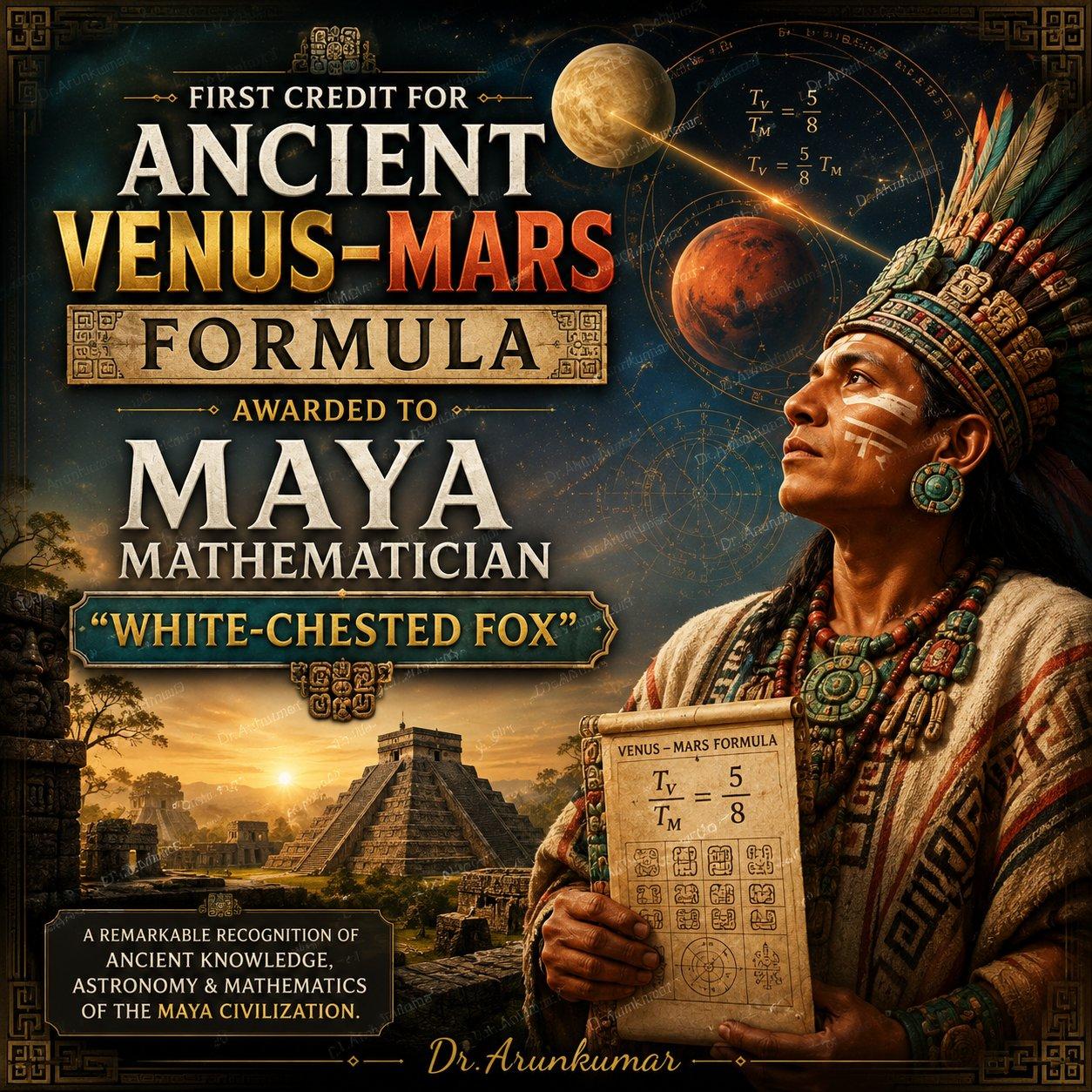


Around 781 CE, a Maya scholar at the ancient city of Xultun, Guatemala, mapped a 2,920-day astronomical formula relating the orbital cycles of Venus and Mars. Discovered in a residential structure and published in the journal Antiquity, the inscription is signed by Sak Tahn Waax, meaning "White-Chested Fox". This makes him the earliest named mathematician-astronomer in the Americas.
The discovery upends the idea that Classic Maya astronomical tables were only the anonymous work of the state. While kings and political figures were historically credited in stone carvings, this microtext is the only known intellectual work from the Classic period (250–900 CE) to bear its author's direct signature.
▫️The Formula: The 2,920-day cycle aligns exactly with 5 Venus synodic orbits (584 days each), reconciling multiple Maya calendar cycles.
▫️The Location: Found in Structure 10K-2 at the San Bartolo-Xultun archaeological site, the calculations served practical purposes to dictate rituals, time agricultural cycles, and predict celestial events.
▫️The Researchers: The text was decoded by an archaeological team, including researchers from MIT, who have been studying the Xultun murals since 2010.
#MayaAstronomy #ArchaeologyNews #AncientHistory